

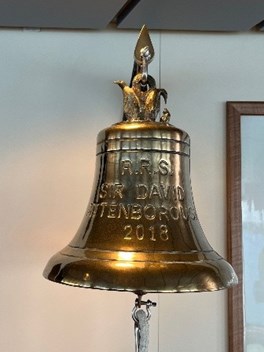
Following an in-depth review of all course material and a visit to assess course delivery, the FPHC endorsed the British Antarctic Survey Medical Unit (BASMU) Advanced First Aid (AFA) and Combined Rescue and Sustained Hold (CRASH) courses in 2023. This led to a recent invitation to visit the RRS Sir David Attenborough (SDA) when she was docked in Plymouth for restocking prior to her departure for the Antarctic. At the time of writing, she is between the Falkland Islands and South Georgia where the weather is described as ‘rough’ with 2.7m waves. 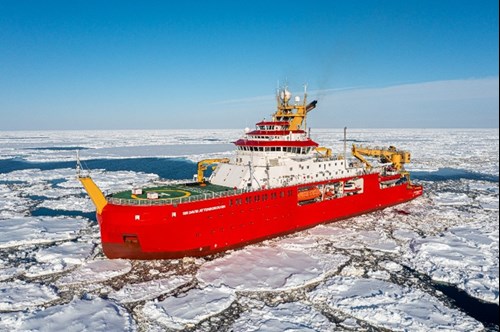
The SDA was launched in 2020 and is probably the most advanced polar research vessel in the world. She has a crew of 30 to operate all aspects of the ship and carries 60 scientists undertaking air, aerosol and biological sampling as well as geological, geophysical and oceanographic studies. The dynamic positioning system allows the ship to hold its position even in rough seas or when surrounded by ice which is essential to facilitate these scientific studies. The ship is equipped with autonomous underwater vehicles, including the notorious Boaty McBoatface; ocean gliders which can be deployed for up to 1 year; and 2 Remotely Operated Vehicles. It can also deploy unmanned aerial vehicles and drones to monitor ice thickness or wildlife in remote areas. All of these capabilities are backed up by impressive on-board laboratory facilities. The ship’s range is 22,000 miles and she can spend up to 60 days at sea without refuelling. Crew accommodation and recreational facilities are exceptionally comfortable.
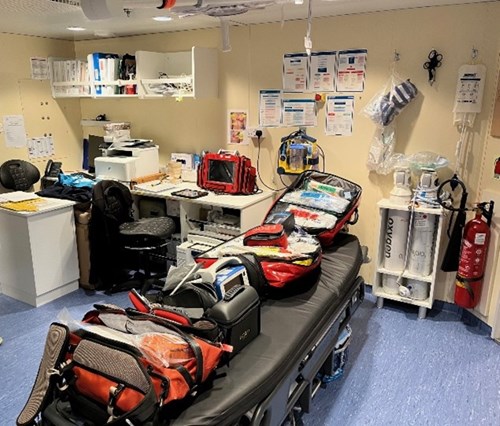
British Antarctic Survey (BAS) operate 5 permanent research stations in the British Antarctic Territory as well as 2 stations on South Georgia. Two stations on the continent are manned by a doctor and there is a doctor on board the SDA. The ship is equipped with resuscitation equipment, point-of-care testing, basic XR facilities, ultra-sound scanning and a (very) wide range of drugs. It also has a 2-bedded ward.
Doctors deploying to the vessel are usually GPs with recent ED experience, or ED registrars, and they undertake an 8 - 9 month tour on board. Prior to deployment, they undergo a 6-month training course which is tailored to some extent dependent on their existing skills but includes dentistry, radiography, physiotherapy, mental health, sedation, dive medicine, environmental medicine and sea survival. They also complete the 6-day CRASH Course in Dartmoor, with other members of the BAS team, covering advanced medical skills, rescue techniques and prolonged casualty care focused on the working conditions and risks of Antarctica.
The medical teams on the ground, and on the SDA, have excellent reach-back support from University Hospitals Plymouth NHS Trust ((UHP)UH) covering all specialties. For example, developments in ultrasound telemedicine using improved bandwidth have enabled real-time radiology consultant support to guide image acquisition and provide real-time support to stations or even more remote locations. This should aid diagnosis or exclusion of suspected pathology thereby guiding medical urgency or potentially enabling an individual to be managed in the field. Unsurprisingly, medical evacuations from Antarctica are complex, high-risk operations involving specialised aircraft and crews to cope with extreme cold, darkness and remote locations. For significant parts of the year, they are impossible.
The capability of the Sir David Attenborough team encompassing crew, scientists and medical support both on-board and through reach-back to UHP was impressive and I was grateful for the opportunity to tour the ship and speak to members of BASMU and UHP.
Dr David Bruce, Chair FPHC Training and Standards Committee
Due to essential systems maintenance and upgrades there will be intermittent interruptions to some on-line services on Saturday 27th of February. There will be further interruption to some core services on Wednesday 2nd and Thursday 3rd of March.
We apologise for any inconvenience caused.
× Back to News Home